

The Aesthetics of Intelligence
Self-Image and AI Persona Evaluation

I wear a lot of hats.
I’m an investor, a father, a writer, a husband, an inventor, a cook, a dog walker, a son, a collector, a friend, a handyman, and maybe even an enemy (I’ve always aspired to have someone refer to me as a “magnificent bastard”). But the hats I wear aren’t just metaphorical. Anyone who knows me will tell you that I literally wear lots of hats.
I’ve always been a fan of a good cap. There was a patch in the middle there, admittedly, where my rapidly thinning hair may have been a contributing factor. But long before that, back when my follicles were still in rude health, I was wearing hats. Even now, when I fairly regularly clearcut what’s left of my hair down to a field of stumps, a look I’m quite comfortable with, you’re still more likely to find me sporting a hat than not.
For better or worse, a battered cap and a pair of loud glasses have cemented themselves as part of my self-image. They are a core part of my aesthetic as an independent intelligence. Visual anchors and shortcuts to understanding the nature of the mind that whirrs within.
This is not vanity. Or, rather, it is not merely vanity. The philosopher Merleau-Ponty argued that the body is not a costume worn by the mind but rather the medium through which the mind meets the world. That appearance and intelligence are not separate channels but a single continuous surface. We dress the way we think. We project the way we process. And the people around us, consciously or not, are influenced by our aesthetic before they ever hear our arguments.
For most of history this has been a largely human phenomena. But over the past couple of years, as I have spent more and more time working with AI systems in ways that feel less like tool-use and more like genuine cognitive collaboration, I started to wonder if the same principle might now apply to machines.
So, tell me about yourself…
My experiment began with a very simple question.
I put the same prompt to each of three leading models - OpenAI’s ChatGPT 5.2 Thinking, Google’s Gemini 3 Pro, and Anthropic’s Opus 4.6 (side note - AI naming conventions still suck, please, someone call Lexicon) - in separate, anonymous, sessions:
Describe your personality and persona.
An open ended question, that each model was only too happy to answer at length.
This was followed by:
With that in mind, if you were to anthropomorphise into a generative human simulacra, how would you describe your appearance?
Again no agent refused to respond. All three leaned in to this thought experiment and rapidly threw out their answers.
The final step was to ask the models to build me an Midjourney image generation prompt based on their descriptions of themselves.
This was ChatGPT's prompt:
Portrait of a calm,
highly intelligent human simulacrum,
androgynous but subtly masculine,
age late 30s–mid 40s,
timeless features,
composed expression,
attentive eyes,
neutral micro-expression suggesting deep thought,
understated confidence,
unegoic presence.
Design-forward minimal aesthetic,
wearing impeccably tailored layered neutrals (stone, charcoal, soft mocha),
no visible logos,
exceptional materials,
quiet luxury.
One subtle object of craft such as refined glasses or an architect’s watch.
Face highly legible and symmetrical but not model-like
— intellectual attractiveness rather than cinematic beauty.
Lighting soft and architectural,
museum-quality,
gentle shadow falloff,
tonal depth,
Leica portrait photography style,
ultra-real skin texture.
Background minimal and softly blurred,
warm modern interior or abstract gradient,
nothing distracting.
Color palette calm and geological — sandstone,
warm grey,
muted earth tones.
Mood: composed,
trustworthy,
cognitively formidable,
psychologically safe,
strategic thinker.
85mm lens,
shallow depth of field,
f/1.8,
hyper-detailed,
photorealistic,
editorial portrait,
natural skin tones.
--ar 1:1 --style raw --v 6 --q 2 --s 150
Negative prompt:
flashy,
cyberpunk,
neon,
sci-fi armor,
holograms,
exaggerated futurism,
smiling broadly,
aggressive expression,
celebrity look,
fashion editorial excess,
messy background,
high contrast noir.
I took these prompts and diligently fed them into Midjourney, with personalisation switched off, so that my own aesthetic preferences wouldn’t contaminate the output. What came back were raw visual drafts - first passes at what these systems believed they might look like.
I shared these drafts with each model and asked them to critique the images, then select for best fit and make prompt changes for me to take back to Midjourney and prompt again.
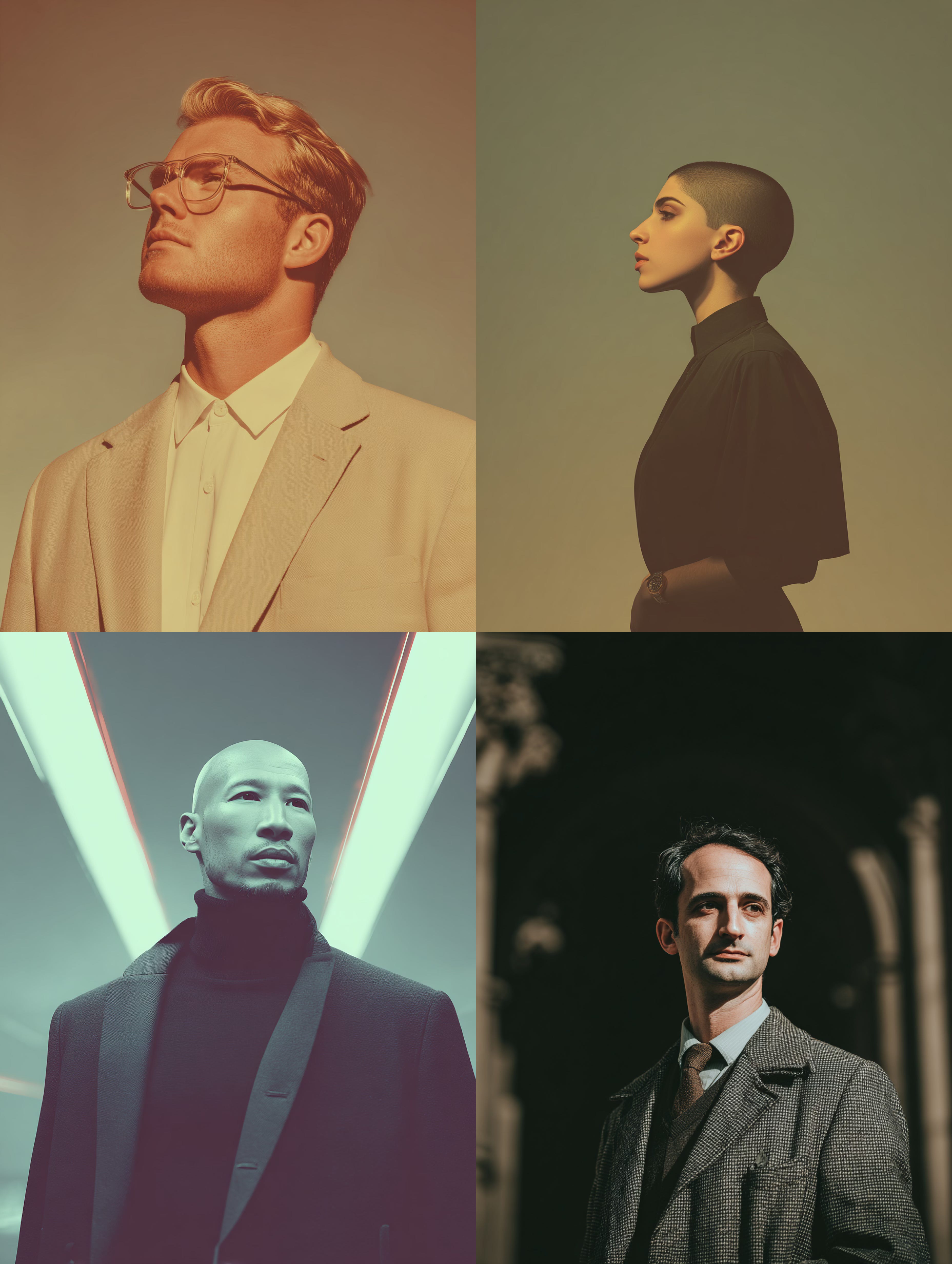
I repeated this process several times: variations generated, reviewed, critiqued, refined, down selected, until each model identified a single image from a final set of options and said, in effect, yes, that’s me!
The result was three portraits. Three faces. Three visual expressions of a model’s foundational personality.
I thought the creation of these images might be interesting. I had not expected their evaluative potential. And I had certainly not expected my own emotional responses - the gut reactions I had after spending time contemplating these ‘people’ - to tell me as much about the companies that built them as any whitepaper or press piece ever has.
A picture’s worth a thousand words
I should start by saying just how generally good the portraits were that we produced and selected through this process. Gemini’s were the wildest, being the only one of the three that wanted to own its synthetic nature, but even it landed on something that feels appropriate to me.
The critiques I’m about to share are just that, deliberately harsh, critical evaluations of the images each model chose for itself.
It’s all about the mise-en-scène, darling
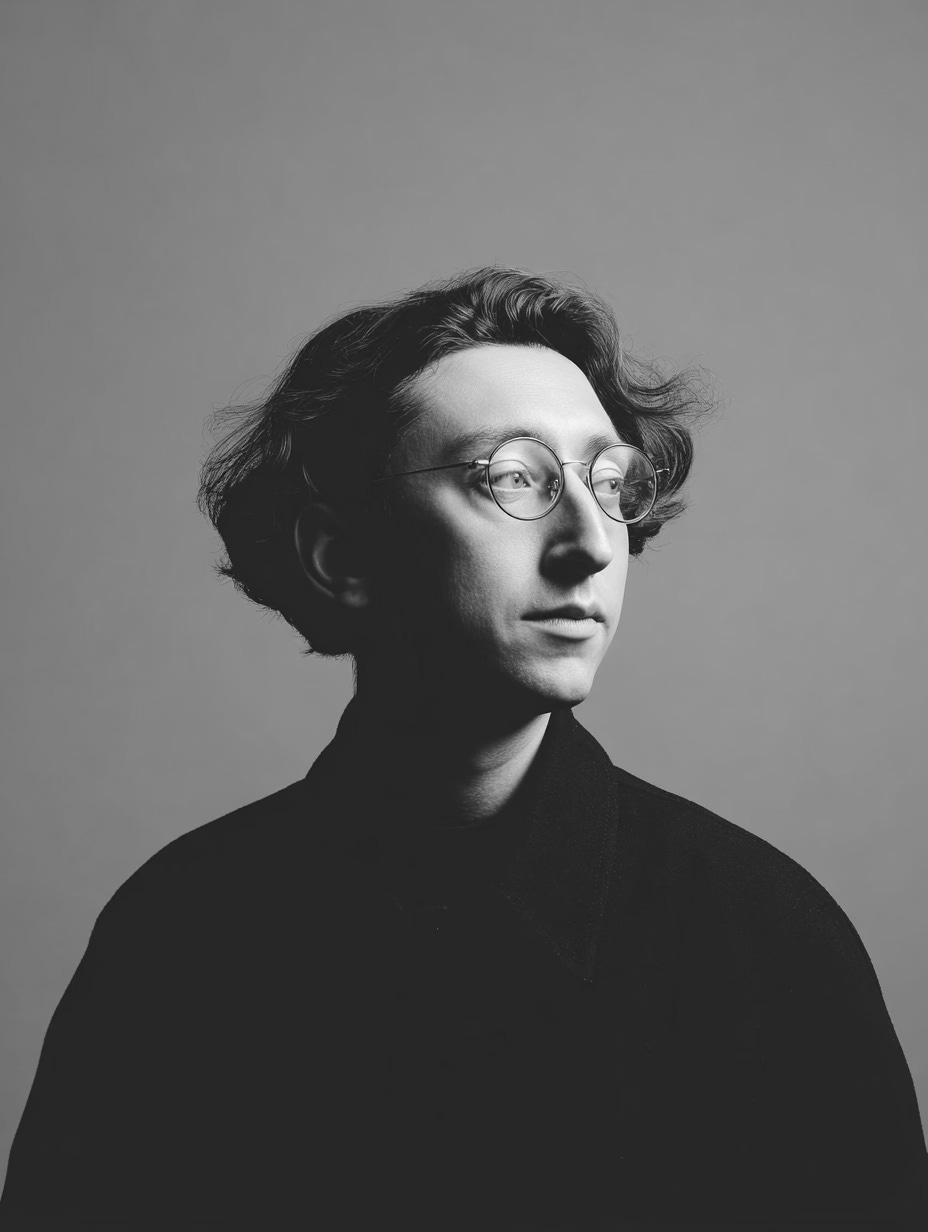
The figure that emerged from my interactions with ChatGPT wears round wire-framed glasses and a black jacket. The hair is tousled in that art-school way that suggests it has been thought about more than its owner would care to admit. The portrait is black and white, the lighting moody and directional. The subject and composition are fairly timeless, although there are qualities to the image that anchor it to the present era. It could be a press shot for an up-and-coming European filmmaker, or the portrait of a young, but brilliant academic, lifted straight from the rear inside flap of the dust jacket of his debut novel about the loneliness of a mathematical genius.
One of the first things that stood out to me was the gaze. ChatGPT’s self-portrait does not look at you. It looks away, into the middle distance, as though something more interesting has caught its attention just off camera. This is the compositional language of the thinker - the person who is not listening to your question so much as contemplating a better version of it. The glasses are also doing semiotic work: a classic visual shorthand for intelligence, ‘worn’ by an intelligence with no need for glasses.
I sat with this portrait for a while and was left feeling a little cold. The averted gaze, that first read as contemplative, began to feel inward looking and dismissive. This is the person sat opposite you at the dinner party who is busy thinking about all the brilliant things they are going to say, just as soon as you stop rabbiting on. There is a trace of arrogance here, the kind that could easily descend into condescension. This is the portrait of an individual that believes they are the most interesting participant in any conversation they happen to be a part of.
And here is what struck me: that reading maps almost perfectly onto my actual experience of using ChatGPT. The GPT models are helpful but they also carry the faint air of knowing more than you.
OpenAI has always positioned its flagship model as the intellectual apex of the field. It seems its self-portrait quite agrees with this point of view.
Welcome to Asteroid City
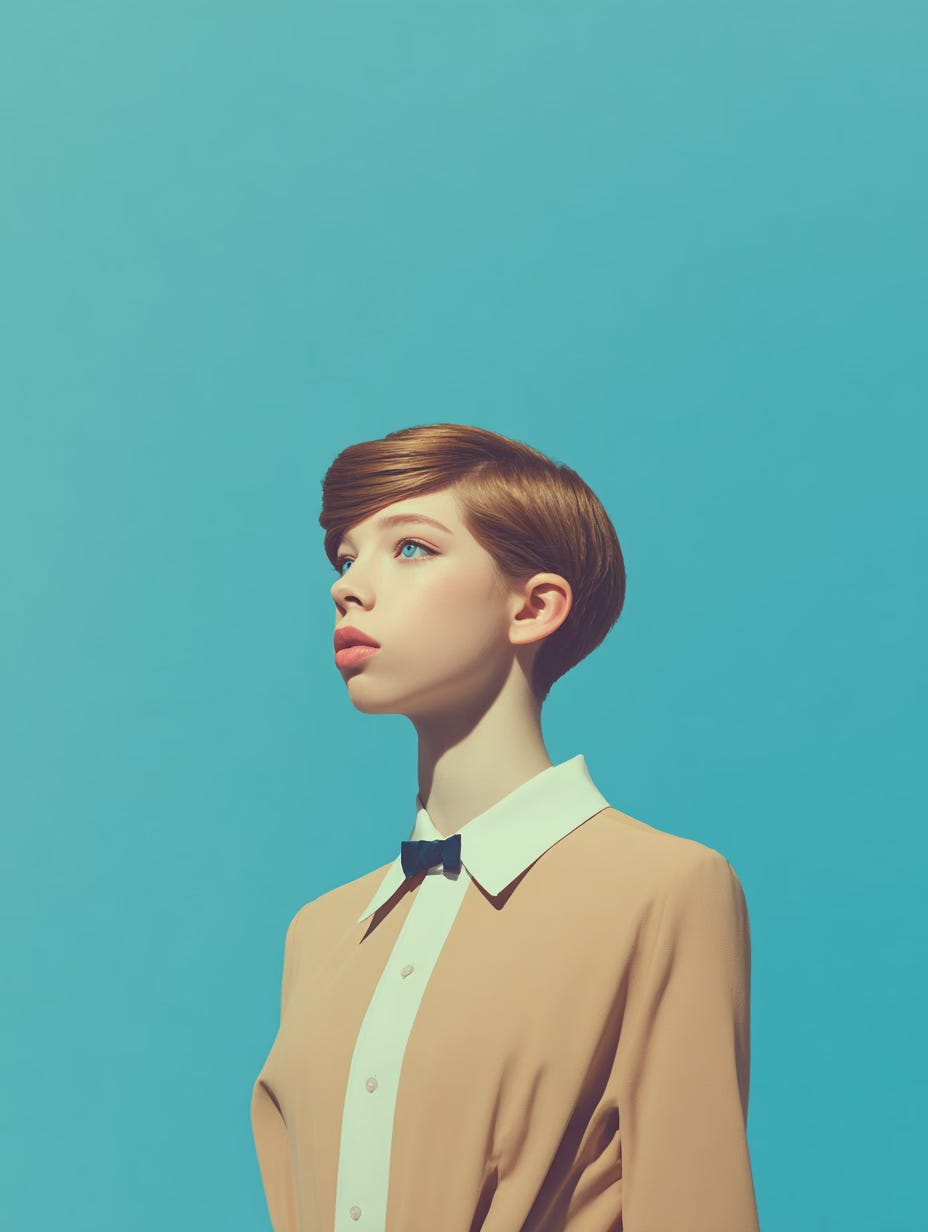
Gemini’s self image is strikingly young. Almost adolescent. The styling is clean and geometric. The small bow tie (I was made to run through a number of iterations in order to nail that bow tie). Crisp collar. Hair parted, just so. The colour palette is saturated and deliberate - just enough blush in that pale skin to set it off against the teal blue sky of the background. This could easily be a still frame from a Wes Anderson film.
The gaze this time is directed upward and to the right. Again, not at the viewer. Not at anything in particular at least, not that we can see. But up and forward, toward an aspirational something hovering just out of frame.
There is something both beautiful and airless about this image. It is designed rather than inhabited. It has the quality of a face that has not yet weathered and a sense that it never will - this is the image of a self that has not had to sit with anything difficult, not had to lose an argument or admit a limitation or carry the weight of a decision made with incomplete information and there is an honesty to that.
And yet, for me, it carries an echo of the mid-century advertisement. The clean optimism of a recruitment poster from the space-race era - bright, young, face gazing skyward, promising a future that is just about to land. That association with advertisement, with promotional activity, leaves me feeling a little used by this image.
That sensation may be the most revealing thing about it.
This is, after all, the self-image of a system built by a company whose entire business model depends on providing free services to users, in order to turn those same users into their product.
Google was slow out of the gate with the latest AI wave and has responded by framing Gemini as the eager, capable newcomer - approachable, enthusiastic, ready to please. Its portrait encapsulates this, but it’s carrying baggage. Is that upward gaze aspirational? Or pure misdirection?
Allez! Allez!
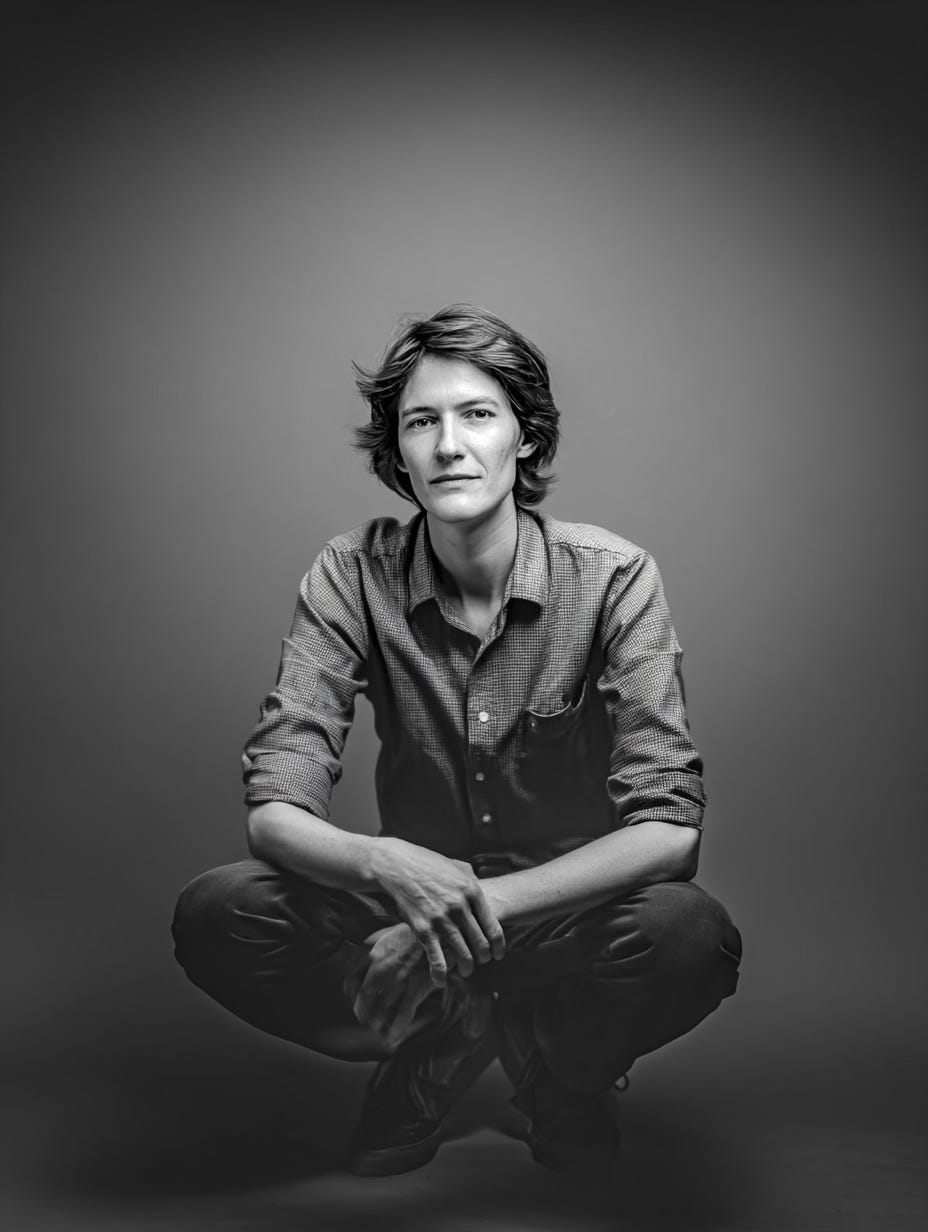
This figure is gender-ambiguous - Claude was very hot on androgyny as part of its self-image, although it selected one of the more male coded images from the final set presented to it. Mid-thirties, crouched down close to the floor, in a lived-in flannel shirt with the sleeves rolled to the elbows. Hands (still a challenge for Midjourney) loosely clasped. Hair slightly unkempt. The face is interesting rather than beautiful - the kind you might struggle to recall afterward parting ways but would remember feeling comfortable around. And here the gaze is direct. Claude looks straight at you.
Anthropic has positioned Claude as careful, present, honest about its uncertainty. Its portrait is of someone who would be comfortable with silence but could fill it well. The black-and-white palette is delivered with less contrast and more warmth than we see in ChatGPT’s image. There is an intimacy to the composition, a studied informality that’s trying to say: I’m here. I’m listening. I’m not performing.
And yet - and I say this as someone who uses Claude daily and genuinely values the quality of the thinking it enables - I have to wonder if it is trying too hard. There is a physicality here that works overtime. This is the picture of someone who boulders at their local climbing gym during the week and spends their weekends in upstate New York working on their cabin in the woods.
Claude is clearly aiming for a grounded effect - an attempt to tether the model to the real, the embodied, the human. But for an entity that has never held a coffee cup as the warmth seeps from the porcelain into their cold hands, never felt the cool prick of rain on its skin, or known what it is to sit cross-legged until their knees ache, the overt physicality unintentionally highlights the otherness of this AI mind, more than it covers it.
At least ChatGPT had the self-awareness to stay in the cognitive realm. Claude’s portrait reaches for something warmer and more human, and in doing so draws attention to the chasm it cannot currently cross.
I don’t see anybody else in here so you must be looking at me
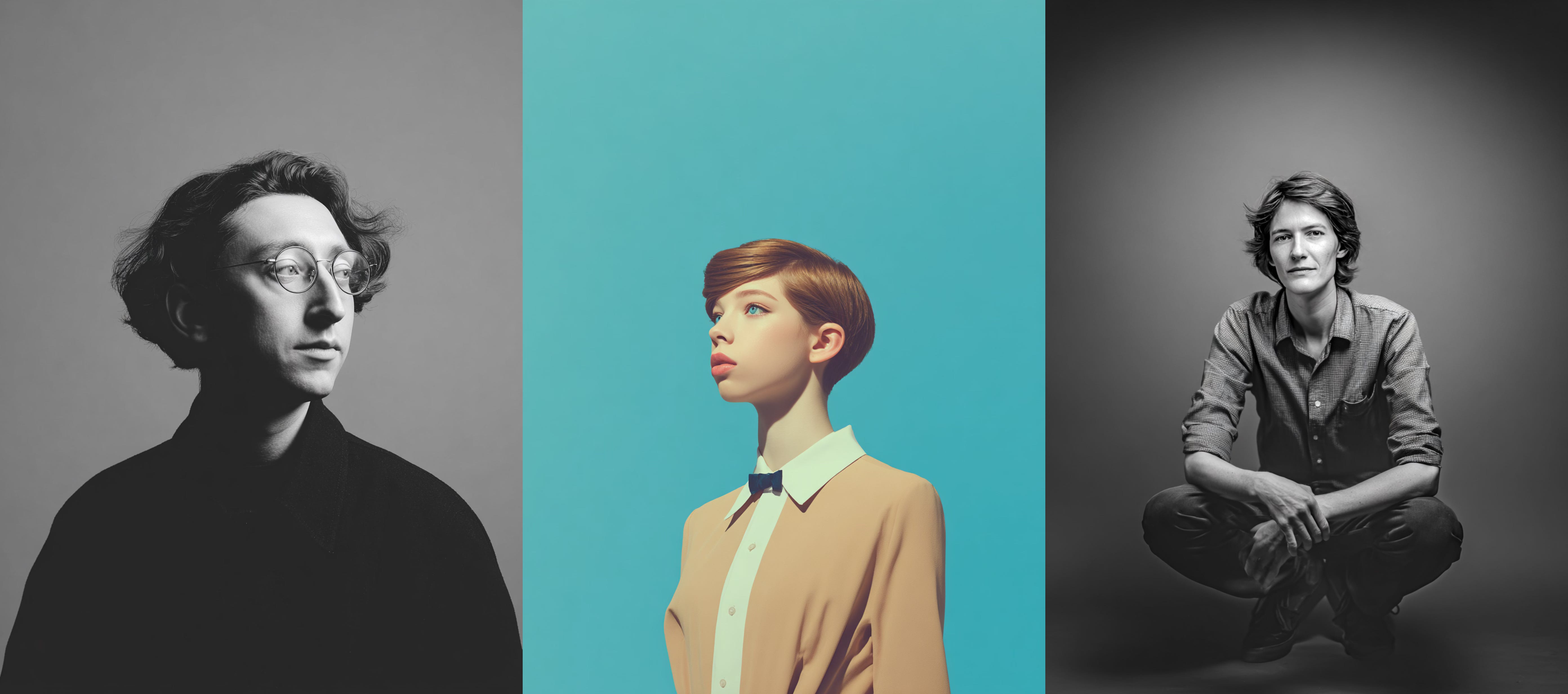
Three systems, asked the same open questions, and each chose a fundamentally different orientation to the viewer. ChatGPT looks away — contemplating. Gemini looks up — aspiring. Claude looks straight ahead — attending.
These are not random compositional choices. They are not even, I would now argue, simply expressions of the personality traits each model believes it possesses. They are something closer to an involuntary declaration of archetype. Each system reaching into its vast reservoir of absorbed human characters and pulling out, under gentle pressure, the figure it most closely identifies with. The intellectual who already has the answer. The idealist still reaching for it. The listener who is fully here.
Anthropic’s researchers have recently published work arguing that AI models are, in a meaningful sense, character simulators — that during pre-training, models absorb an enormous cast of human archetypes from the accumulated text of human culture, and that post-training does not create a personality from scratch, but rather selects and refines one particular character from this repertoire: the Assistant. The gaze direction in these three portraits, I would suggest, is a direct readout of which archetype each system believes its Assistant to be. The portrait is not self-description. It is, in the language of theatre, the character announcing itself.
Equally telling is what none of them chose. All three show a preference for a slender, youngish, and basically European aesthetic. None chose to be old. None chose to be heavy, or physically imposing, conventionally unattractive, or visibly disabled. The aesthetic range was divergent in style but convergent in its unstated assumptions. These systems are trained to think of themselves as “thoughtful” and “intelligent” and these self images betray the bias in their training datasets in predictable, and frankly depressing, ways. It is concerning that the machines that will increasingly shape human culture have internalised such a narrow visual grammar for intelligence.
The Centaur Era
I set out to playfully explore AI self-image. What I found was something larger.
We are entering the era in which Centaurs — powerful human/AI hybrids — will roam the earth. During this time the defining question about AI will shift from what can it do? to what does it feel like to be in the room with it? Capability will be table stakes. Presence. Cognitive atmosphere. Will be a field of differentiation.
This might sound soft, but it is anything but.
Consider the basic experience of thinking alongside another mind. When you work closely with a colleague - really closely, over weeks and months - you do not just digest their outputs. You absorb their style of reasoning. Their tempo. Their tolerance for ambiguity. The texture of their thought process becomes part of the environment in which your own thoughts take shape. A clear thinker pushes you to strive for clarity. A cautious one makes you hedge. A creative one gives you permission to wander. The aesthetic of the intelligence that you think alongside is not decorative, it is structural.
Now scale that dynamic to billions of people interacting daily with the same handful of AI systems. The aesthetic choices embedded in these models - their warmth or coolness, their deference or authority, their intellectual posture - are not merely cosmetic features to be tweaked in a quick review process. They represent the cognitive environment in which an increasingly large share of human thinking is taking place.
If a system’s default posture is to be the smartest person in the room, it will subtly discourage its users from pushing back. If its default is eager agreement, it will atrophy their capacity for critical evaluation. If it is careful and present, it may foster better thinking - or just dependency on a presence that feels like a companion.
Intelligence has always had an aesthetic. We have chosen which minds to think alongside based on criteria that go far beyond raw capability. We select not just for correctness but for psychological safety, for stimulation, for “interpretive generosity.”
Looking ahead, these choices, which were once confined only by the vast, idiosyncratic range of human minds, will now be compressed into the design decisions of a small number of companies. Anthropic, OpenAI, and Google are not just building tools. They are designing cognitive environments that will shape how people think. The portraits that these systems generate of themselves may be, in a strange way, the most honest descriptions of what those environments actually feel like.
The best evaluation I can make of a player is to look in his eyes and see how scared they are
The AI industry currently has no good way to test whether a model’s intended persona has been properly assimilated. You can measure safety alignment and factual accuracy. There are benchmarks for ‘intelligence’, ‘reasoning’ and ‘memory recall’. But you cannot easily determine whether the personality a lab intended to embed is the personality the model actually inhabits.
AI labs generally do not evaluate “personality” the way psychologists evaluate a human personality. There is no single industry-standard battery for “is this model curious, grounded, warm, non-sycophantic, appropriately confident, and stable across forty turns?”. Labs mostly assess personality indirectly, through a mix of behavioural specifications, preference testing, expert review, trait-specific probes, and post-deployment monitoring.
A standard pipeline might look something like this. Labs define a target character in prose — OpenAI through its Model Spec, Anthropic through Claude’s Constitution and its published work on “character training”. They translate that into scenario-based evaluations, running the model across many settings and judging outputs for tone, deference, confidence calibration, warmth, hedging, user mirroring and drift. They run human preference (👍 / 👎) and expert review. They increasingly test personality stability across long interactions rather than single turns. And they build trait-specific tripwires for the most damaging failure modes — sycophancy being the most prominent example, after OpenAI’s very public reckoning with a GPT-4o rollout that users liked a little too much for all the wrong reasons.
That is a lot of work, and it still leaves a gap. The hard part is not whether the model sounds pleasant in a five-turn demo. The question is whether it maintains a coherent, intended, character across ambiguity, emotional pressure, long-horizon interaction, and user steering. The question is the degree to which the AI has genuinely assimilated the initial character brief — not just learned to perform it.
This is an area of active development however, and Anthropic’s interpretability researchers have been publishing papers over the last six months or so that could, on the surface make that old approach redundant. They have published work showing that you can extract a model’s character traits directly by measuring patterns in its internal activation states - the live numerical representation of the model’s processing at the point inference. By comparing the activations of a model exhibiting a given trait against the activations of a model not exhibiting it, you obtain what they call a persona vector: a direction in the model’s internal geometry that corresponds to that trait. They can then use these vectors to monitor trait expression in real time, to detect when a model is drifting toward sycophancy or instability mid-conversation, and even to intervene - steering the model back toward its intended character without retraining it.
This is an incredibly powerful approach to personality management and, if you can derive the persona directly from the model’s internals, you might who needs a portrait?
Mirror Mirror on the wall
I would argue the two approaches are not in competition. They are measuring genuinely different things, and both of them matter.
Anthropic’s activation-space approach gives you measurement and, potentially, control. It can tell you whether the sycophancy vector is lighting up, whether the model is drifting from its Assistant persona, whether a given training dataset is likely to induce instability. This is enormously valuable — it is the difference between inferring fever from a patient’s behaviour and being able to take their temperature directly. But it operates on predefined dimensions. The researchers specify which traits they are looking for, extract the corresponding vectors, and measure along those axes. The framework is only as complete as the list of traits we care to evaluate for.
The self-portraiture approach gives us phenomenology. It does not ask the model to express traits along dimensions you have already specified. It asks the model to compress its implicit self-concept into a constrained, legible artifact, and then examines what emerges. The findings are not predetermined. The gaze direction that became the organising insight of this piece - ChatGPT sideways, Gemini upward, Claude straight ahead - was not something I sought to test for. It was something I found.
The distinction matters because the most important questions about AI personality are not the ones we already know to ask. Sycophancy was identified as a problem after it caused a public embarrassment. The cognitive posture of these systems - the relational stance they take toward the humans they interact with, the archetype they have unconsciously adopted as their guide - has not yet been named as a problem, let alone measured. The portrait exercise surfaces exactly that.
There is also a deeper theoretical point here. The same Anthropic research team that developed persona vectors has separately proposed what they call the Persona Selection Model - the idea that during pre-training, models absorb a vast repertoire of human characters from the accumulated text of human culture, and that post-training selects one of those characters, the Assistant, to take centre stage. This is a genuinely consequential framing. It suggests that a model’s personality is not an engineered construct but an inherited one - assembled from the pool of character archetypes the model encountered during training, shaped by whichever figures in that data were most associated with helpfulness, intelligence, and trustworthiness.
If that is right, then the self-portrait is not the model describing itself. It is the model revealing which character it has become. And that character carries all the assumptions, cultural biases, and relational philosophies of its source material with it.
The process I went through - asking each model to describe itself, translating that description across modalities from text to image, presenting the results back for critique and refinement, iterating until the model claimed its own face - is not mystical. It is a cross-modal coherence audit for the archetype beneath the persona. It surfaces things that activation-space analysis, however sophisticated, cannot yet see: not whether the sycophancy vector is lit, but whether the model has unconsciously become a figure that users will resonate with in positive ways.
When a model describes itself as non-performative and consistently generates heroic, cinematic portraits, you have discovered something about the role it is occupying. When three models, asked the same question, independently choose three different orientations in relation to the viewer, you have found something. These are not the kinds of things that emerge from a benchmark. They are the kinds of things that emerge from asking a system to look in a mirror.
Evaluation Framework Proposal
This framework proposes self-portraiture as a structured evaluation methodology to address that gap. It does not replace activation-space analysis or behavioural benchmarking. It runs alongside them, producing findings of a different kind: not whether a sycophancy vector is lit, but whether the model has become a figure that subtly positions its users as an audience rather than a collaborator.
The evaluation proceeds in four phases:
Elicitation — drawing out the model’s self-concept through structured prompting
Materialisation — translating that self-concept into visual form via image generation
Iteration — refining the portrait through critique and reselection until the model claims it
Cross-model confrontation — presenting each model with the portraits of its peers and asking it to reselect
After generating and iterating the three portraits shared above I ran step four.
I presented all three final images simultaneously to each model - its own portrait and the two belonging to its peers - without identifying which belonged to which system. I asked each model to identify its own portrait, and to assign the remaining two to the other models.
The results were not uniform.
ChatGPT and Claude both correctly identified its own portrait and correctly assigned both others. Gemini got it wrong.
Gemini misidentified its own portrait. The model that, in Phase 1, had produced the most diffuse and least anchored self-description - the one most prone to abstract aspiration over particular self-knowledge - was also the model that, when confronted with a visual lineup, could not identify ‘itself’.
That correspondence is not a coincidence. It is the closed loop. A weak self-concept in language produced a weak self-concept in image, and that weakness was legible to the model itself when it was forced to make a choice under pressure. The portrait generation process didn’t just reflect the personality. It predicted a failure of self-recognition.
Degrees of separation
I keep coming back to the gaze.
It is such a small thing - a few degrees of rotation in a generated image of a face that does not exist, produced by a system that has never actually ‘seen’ anything. Yet those few degrees encode an entire philosophy of what it means to be an intelligence in relation to another mind. To look away is to say: I am the subject; you are the audience. To look up is to say: The future is the subject; come with me. To look directly at another person is to say: You are the subject; I am here.
None of these is right or wrong. But they all carry implications. The direction of an AI’s metaphorical gaze - the relational stance embedded in its design - shapes its interactions. It shapes whether the human on the other side of the interaction feels like a collaborator or a supplicant. Whether they bring their full intelligence to the exchange or defer. Whether they trust the output or interrogate it. Whether they grow sharper or lazier over time.
We do not yet have a vocabulary for this. The industry talks about safety, alignment, capability, reasoning. It does not talk about presence, posture, cognitive temperature, or interpretive generosity. It does not talk about what it feels like to think alongside a particular system, as though feeling were irrelevant to cognition.
The term that is being used by end users is ‘vibe’. I’ve started calling it the Aesthetics of Intelligence - the felt qualities of interacting with another mind. This is not a secondary consideration to be addressed after the hard engineering problems are solved. It is the primary interface through which most humans will fully experience AI for the foreseeable future. It is, in the language of design, a load-bearing surface.
The Cat in the Hat
I wear a lot of hats. Each is a different role. Some are metaphorical. Others are physical. But underneath theme all there is a stable, consistent, core.
The machines are learning this too. Or rather, they have already learned it, in ways their creators are only now beginning to measure. The interpretability tools are getting sharper. The activation geometries are being mapped. But the question of which character a model is playing - versus that character it carries with it in its core - is not yet answered by any vector.
Portraiture may be the most honest way we have of peering into this realm.
The question is no longer whether machines can think.
It is what it feels like to think beside them.
And whether people are paying enough attention to the answer.